Showing posts with label Movie Review. Show all posts

Wednesday, 3 January 2018

Three Billboards Outside Ebbing, Missouri Review


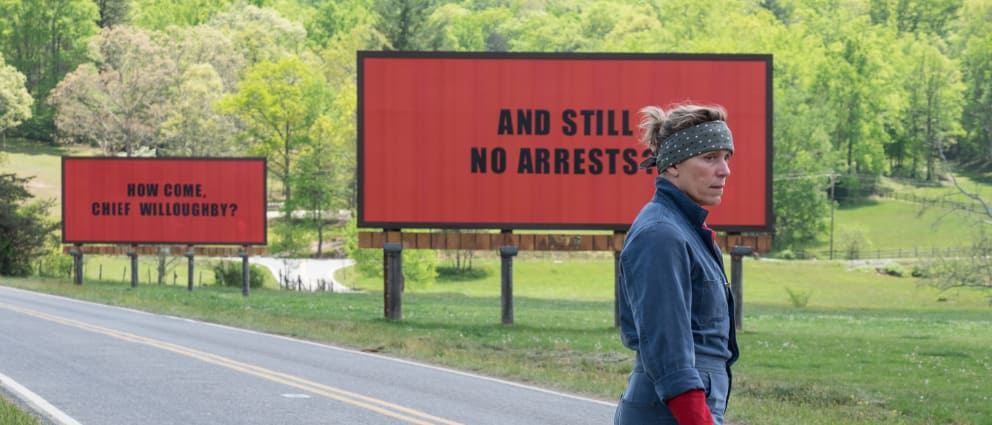
7 months after the rape and murder of her teenage daughter Mildred Hayes (Frances McDormand) hires the use of three run-down billboards located near her home and the site of her daughter's death. Frustrated with the police's lack of progress in identifying the criminal she pays her them to read "Raped while dying", "And still no arrests?", and "How come, Chief Willoughby?" The police view this is a personal attack and thus begins a war between a grieving mother and a conservative small town police department.


As always McDormand is great in the lead but her role is more subdued here than one might think from the initial plot. As the film progresses Mildred begins to fade into more of ensemble of intriguing small town characters, particularly that of the Ebbing police department. Chief Bill Willoughby (Woody Harrelson) is never portrayed as the villain he could he here, nor does Mildred's character hate him, but the fact she has no closure regarding her daughters death. The news that he is suffering from terminal pancreatic cancer adds another interesting dimension to his and Mildred's game of trying to best one another, but is also hinders the films ability to show truly enraged characters and therefore to emotionally move the audience as much as the film could have.


The closest we get is openly racist and seemingly incompetnet Officer Jason Dixon (Sam Rockwell) who snaps after a particularly fatal blow for the Ebbing police department and brutally assaults Red Welby (Caleb Landry Jones), the advertiser Mildred is paying to maintain the billboards. Unfortunately, what the film excels at in creating three-dinmenisonal characters is also its downfall. We see the fervent passion of love and hate from both sides of what turns out to be mostly a series of misunderstandings and minor differences, but ultimately all the characters still remain human enough to be understood and related to by the and receive redemption by the films end.

Rating: 3.5/5

Tuesday, 10 October 2017

Blade Runner 2049 Review


Re-watching a film right before a sequel is sometimes a bad decision. On the one hand it ensures you're up to speed with everything that's happened before jumping back into the franchise's world again. On the other hand it means there's more opportunity to draw comparisons and discrepancies. I don't regret re-watching Blade Runner before going to see 2049, but unfortunately for me it meant 2049's validity was put into question almost immediately when the entire premise of the original - that replicants can only live for four years - became superfluous in 2049's opening crawl, stating the Nexus 8 generation of replicants (somehow created around the time the first film look place) have no live span. And once you start to question the validity of a film's continuity the suspension of disbelief is hard to get back.

So when K's (Ryan Gosling) investigation into the bones he discovers hidden by another older model replicant indicates the robot had carried to birth a child you have to just take a breath and go along for the visually breathtaking ride and not think too hard about it. That's a shame though, because much like the original, there are some interesting ideas here, about identity, memory, morality and love but they get lost in translation. Instead of pondering these themes you're trying to uncover 2049's puzzling mystery: who is the child to the replicant and the human, and why does everyone want it so badly? It's a welcome addition to the more straight-forward narrative of the original, but again, there's too much going on to fully enjoy it - which is really quite a feat for a film you can also describe as slow-paced.

Gosling is fine, but he's outshone by the late arrival of Harrison's Ford's Deckard, and he basically suffers from the same problems Harrison had with Deckard in the first film but in reverse. Ford had to play a human that you could potentially believe was a robot, whereas Gosling must play a robot that you just might think is human. Ana de Armas and Robin Wright both perform well, but their characters are mostly unnecessary filler, particularly Armas's Joi whose hologram characters existence confuses me. Sylvia Hoeks is the standout as the beautifully menacing replicant Luv, assistant to the underused Jarrod Leto's Wallace, head of the Wallace Corporation.

If you liked the first film, it's highly likely you'll enjoy 2049 even though it's a highly more convoluted version of the original.

Tuesday, 26 April 2016

The Jungle Book Review


A 'man cub' named Mowgli has been raised in the jungle by wolves and trained in their ways. Not all of the animals in the jungle accept his presence, however, and a tiger named Shere Khan vows to kill Mowgli and anyone that stands in his way. The wolf pack argue about whether or not they should protect Mowgli, so for their safety he offers to leave the jungle. A panther named Bagheera offers to return him to the man village, but on there trek out of the jungle Shere Khan attacks and they are separated. Mowgli if then left to fend for himself in the jungle where many friends and foes await. him.

The voice cast is superb. Bill Murray is perfectly cast as the lazy bear Baloo, while Ben Kingsley for once has a more restrained role as the protective panther Bagheera, and Lupita Nyong'o is used much better here as the wold mother Raksha than her voice role in Star Wars: The Force Awakens. Christopher Walken is fine as the monkey King Louie, although his character suffers from attempts to re-enact the original role; if only Scarlett Johansson's Kaa, the seductive snake, suffered the same problem, as she is miscast and underused here. The standout though is Idris Elba as the menacing tiger, Shere Khan, and he easily brings to life one of Disney's scariest villains of recent history. Not to be forgotten is Neel Sethi as Mowgli, who despite having to act alongside presumably nothing but green-screens does a convincing job and is undeniably likeable.

As with their voices, the animals look stunning, but direction choices like the inclusion of animation at the beginning and the end of the film, as well as constant action sequences often makes the scenery blur throughout the film and it becomes evident the 3D market was definitely thought about while making it.

Storywise, the film improves on the original Disney classic in almost every way. Mowgli's introduction to the jungle is integrated nicely throughout a flashback by Kaa, also enabling an interesting backstory and motivation for the central villain in Shere Khan - aspects the original never bothered to develop. A lot more time is also spent with Mowgli's wolf family giving the film a much needed sense of emotion, which helps improve both the lighter, and the darker aspects of the films territory. The only disappointing, and bizarre, part was the decision to not have the elephants and monkeys (other than King Louie) talk, when every other animal in the jungle can. Although it is potentially a bit long it moves very briskly for a film that as so much going on. The ending is also very curious as Mowgli, despite becoming aware that he is a boy and will grow into a man, decides to stay with the wolf pack, although ultimately this differentiation is inconsequential to how good a film The Jungle Book is.

Rating: 3.5/5

Monday, 15 February 2016

Deadpool Review


Deadpool follows Wade Wilson (Ryan Reynolds), a former mercenary who spends his time in New York threatening unfavourable people for money. At the beginning of the film he is known as Deadpool, an antihero with accelerated healing powers and agility. He is also permanently scarred and therefore wears a red suit to hide his face (as well as the blood he is prone to stain his clothing with). He is desperate to find the man responsible for his disfigurement and acquisition of superhuman powers, Francis Freeman (Ed Skerin), in an attempt to regain his looks, and as he hunts the man down we are shown through flashbacks how Wade Wilson became Deadpool.

The film manages, for the most part, to skillfully weave in between the present and the past with ease without it becoming tedious. A lot of that has to do with the breaking of the fourth wall. Deadpool often turns to the audience and talks to them directly, a different and daring approach to the standard superhero movie. It's also very self-referential, with Deadpool discussing the movie, the Marvel franchise, and even Reynolds himself. It instantly disarms the audience in the best way, ensuring that wherever the story takes them that they're still in on the joke.

Speaking of jokes, Deadpool is funny. I'm not too much of a fan of the smart-ass superhero (I'm looking at you Tony Stark), but Deadpool does it so well to an unrelenting script and Ryan Reynolds who has never been more charismatic. He's not the only one though, the film is inundated with hilarious characters. Morena Baccarin is surprisingly effective as Vanessa Carlysle, Wade's girlfriend, and a lot of the enjoyment of the earlier part of the film and the flashbacks has to do with the chemistry and humour she shares with Reynolds (even if her character is underdeveloped and has little to do later on). There's also Weasel (T.J. Miller), a bar owner and Wade's best friend, Blind Al (Leslie Uggams) Deadpool's roommate in the later part of the film, and Dopinder (Karan Soni), a taxi driver, who all have varying degree of importance in the film but are all memorable and also exemplify  the film's humour.


Not every character does though. Francis and Angel Dust (Gina Carano) aren't compelling villains in the slightest, besides the fact that they run the Weapon X program that resulted in Wilson's transformation into Deadpool. Similarly, the writers decided that Deadpool needed some other mutant friends and subsequently inserted Colossus (Stefan Kapičić) and Negasonic Teenage Warhead (Brianna Hildebrand) into the film. Although the film is very self-aware in this regard it's still painfully jarring visiting Charles Xacier's School for gifted youngsters and only being privy to these two X-Men.

It's from the point where the aforementioned characters become prominent parts of the film, and after Wade's intriguing backstory has been fully divulged, where things start to unfortunately return to a stock-standard Marvel movie. Francis and Angel Dust kidnap Vanessa to lure out Deadpool, and he, along with Colossus and Negasonic Teenage Warhead have to go save her. What makes matters worse for the traditional third act showdown is that the stakes are so very low. Sure, it's nice to have a more grounded and smaller Marvel film for once (a la Ant-Man), but with all the interesting plot out of the way the ending has nothing left to really on but the film's humour, which by that point surely would have grown old of majority of the more mature audience members.

It's a small price to pay though for an otherwise surprisingly enjoyable, often meta, and constantly funny film.

Rating: 3.5/5

Saturday, 2 January 2016

Joy Review


Joy is a semi-biographical dramedy following the life of Joy Mangano, a woman who overcomes her dysfunctional family life as well as the difficulties of building a business from nothing, to invent the Wonder Mop in the 1990's.

The film starts off as a surprisingly funny one considering the potentially dry material. Joy (Jennifer Lawrence) is struggling to run a household which includes her bed-ridden mother, Terri (Virgina Madsen), her grandmother Mimi (Diane Ladd), her two children, and her ex-husband Anthony (Édgar Ramírez), who lives in their basement. Things become even more complicated when her father Rudy (Robert DeNiro) is dumped on her doorstep by his current partner, claiming she can no longer deal with him. It would be easy to evoke empathy with a set-up like this but O. Russell  gleefully paints this family with vivid strokes of outlandish humour, like Terri and her soap operas, or Rudy's inability to not be in love, that instead garner a greater sense of empathy through the familiarity of family. There are however, some more questionable writing choices, like that of having Joy's grandmother occasionally narrate the story, or it's odd use of flashbacks throughout different stages of the film.

Regardless of all this the film does have a plot though and eventually, after moping up glass on her fathers' new girlfriend Trudys' (Isabella Rossellini) boat, Joy is inspired, just as she was as a child, to invent a self-wringing mop. From here she must convince Rudy and Trudy to help her invest in her product after showing them a prototype so that she can manufacture them, but even after placing a second mortgage on her home she is unable to sell her product, when Anthony introduces her to Neil Walker (an underused Bradley Cooper), executive of the recently started cable network shopping channel QVC (Quality, Value, Convenience).

For me personally the film peaks at the end of the second act when Joy successfully markets the Miracle Mop on the QVC network after it had previously failed on the first attempt. By this point she has overcome an appropriate amount of obstacles to make this victory well-earned and inspiring. The writers, however, seem to disagree and the third act begins with the tonally jarring death of her grandmother, Mimi, and from there Joy's problems seem to unnecessarily multiply as once again the validity of her success and dreams are put into question. Her dysfunctional, yet previously endearing, family lose any semblance of kindness as her half-sister Peggy (an unrecognisable Elisabeth Rohm) makes a blunderous business decision behind her back, while her father and his girlfriend are revealed to have given her bad advice about her invention patent at the beginning of the film, and the father of her children stands idly by as all this happens and Joy is forced to declare bankruptcy. The scenes are potentially the most emotionally charged of the film, and Lawrence and DeNiro are given the best material to work with here, but to what end? After a western-esque standoff with a troublesome business partner in which Joy successful solves all her problems the end of the film shows Joy as the head of a multimillion dollar advertising agency in which she helps inventors like herself produce their products for television. It is a very odd ending. She's still taking care of her heartless family, a problem, it turns out, she was never to overcome. And while she's helping those like herself, she no longer comes across as herself, sitting at a big desk, dressed in a fancy suit (something she made a point about not doing before unveiling her Miracle Mop on QVC), no longer in touch with the woman that needed and made that mop. And that's not even mentioning that flashback to her time as girl is which she pronounced she didn't need a prince but seemed to be longing for one now.

Undoubtedly inspiring and surprisingly funny, although tonally problematic, Joy maintains itself to be an enjoyable enough film.

Rating: 3/5

Sunday, 29 September 2013

Riddick Review


Based five years after the events of The Chronicles of Riddick, our titular hero finds himself abandoned on a harsh desolate planet inhabited by vicious Vulture-like flying animals, Viper-like swarms of water animals and packs of Jackal-like beasts. While he is able to best them for a time, even after being mortally wounded, Riddick soon adapts to his surroundings and raises and trains an orphaned jackal-beast pup as his own. Riddick soon realizes, however, that a massive series of storms that are approaching form the distance are unleashing countless more of the Demons, who must keep their skin wet at all times to survive. Desperately needing to escape, Riddick locates an empty mercenary station and activates an emergency beacon which broadcasts his identity and his presence on the planet. Two groups of mercenaries arrive, both after the large bounty placed on Riddick's head, and he must strategically eliminate them one by one in order to steal one of their ships to flee the planet.

Riddick looses the big-budget premise of the second film in the series, The Chronicles of Riddick, returning to its roots and going for the understated sparseness of the first film, Pitch Black, and it's done to much effect. A small group of characters, with conflicting wants that cause tension, as well as an unseen oncoming force that they must work together to overcome, will always be a proven formula for entertaining viewing. As is inherent with the film series, the film's futuristic sets, well-crafted landscapes, and the contrasts between the bright harshness of the planet with it painfully cold nights make it a visual spectacular to watch.


Diesel has really grown to encapsulate the titular hero over the course of the three films, and while he has never been a particularly well-developed character, Diesel provides an enigmatic and often sarcastic portrayal that proves to be fun viewing. The films, unfortunately, have always been too afraid to show the protagonist in a negative light, always hinting at the possibility of a truly horrible character, but always shying away from showing him. Riddick lures the two mercenary factions onto the deserted planet in which he has been abandoned, planning to escape, at no matter the cost. Initially Riddick does set traps that brutally maim and kill some members of the group, but they're all the sort of really annoying and unimportant characters that are killed off in all horror movies, so they're not much of a loss. Once they're all gone, however, and some of the more important secondary characters remain (important in the sense that they've have more screen time, but they aren't necessary any more developed), there's the opportunity to explore this really dark character in Riddick, but ultimately the film choose to make the role of the planets vicious alien inhabitants into the final villain that must be faced, and Riddick's ruthlessness falls to the back burner, pretty much in exactly the same way as it did in Pitch Black.


As mentioned, the mercenaries with which Riddick is ultimately forced to work with vary in their importance, but none really stand out in the film. Jordi Mollà would be the most interesting of the lot as Santana, the unstable leader of the more aggressive mercenary group. Despite a menacing start in which he brutally kills a female prisoner he's been holding captive, his character quickly turns into a slapstick caricature intended for laughs, not scares. Matthew Nable tries his best to bring something to his character Boss Johns, but unfortunately his character is written as a thinly-layered connection to Pitch Black, and serves little purpose in the scheme of the film. Katee Sackhoff's character, Dahl, Johns' second in command, is worst of all, however. While Sackhoff is well-known for playing hardened female characters, it's painful to watch her try to do the same here when her character is unnecessary written as a lesbian, with constant homosexual jabs been thrown about, and where she does a topless scene.

Like the problem with Johns' character, the film also has the difficult task of removing itself from the large mythology the series was left with at the end of The Chronicles of Riddick, and it doesn't do it well. Flashbacks are used at the beginning of the film to convey how Riddick, growing tired in his role as Lord Marshall of the Necromonger as caused uneasiness among his subjects. He strikes a deal with Commander Vaako (a surprising appearance by Karl Urban) for the location of his mysterious home world, Furya, and a ship to get there in exchange for the leadership. Riddick is escorted there by Necromonger guards, and he realises he has been taken to a desolate planet to be assassinated by them, before he kills them escapes. While it was an honourable attempt to still explain how Riddick got into his current situation, it was always going to be difficult doing so, and one can't help but feel that it may have been better if it had been ignored completely. It would have avoided an incredibly long and tedious opening act of watching Riddick have difficulty acclimatising to his new harsh surroundings interspersed with this unnecessary exposition.

Riddick provides nothing new to the formula it has already established, but Diesel is fun in the role, and for a science-fiction/ horror film it definitely does for audiences what it is designed to do.

Rating: 3/5
Monday, 23 July 2012

The Dark Knight Rises Review


During a function celebrating the late Harvey Dent at Wayne Manor, Selina Kyle (Anna Hathaway) posing as a waitress, brakes into a safe of Bruce Wayne's (Christian Bale) and steals his mother's necklace. After she escapes, kidnapping a congressmen in the process, he realises that the brake in wasn't to steal the necklace, but rather to steal his fingerprints.

Patrol officer John Blake (Joesph Gordon-Levitt) assists police commissioner James Gordon (Gary Oldman) in trying to recover the kidnapped congressmen, and in the process Gordon comes face to face with Bane (Tom Hardy), a mercenary hired by John Daggett, Wayne's business rival. Gordan escapes, but is shot, and Wayne realises that, with the use of his fingerprints stolen by Selina, that Daggett is attempting to take over his crumbling company Wayne Enterprises. Wayne, who has confined himself to Wayne Manor for eight years, is forced to take matters into his own hands when Bane attacks the stock exchange and engineers risky investments in Bruce's name, bankrupting Bruce and forcing him to relinquish control of Wayne Enterprises. Wayne entrusts Miranda Tate (Marion Cotillard) to keep full control out of Daggett's hands. She's the creator of a clean energy project designed to harness fusion power that Wayne Enterprises funded before shutting down the project, after learning that the core could be modified into a nuclear weapon. Bane kills Daggett to take control of his infrastructure, and Wayne, as Batman is forced to confront the mercenary, unprepared for the fight he faces, or the link to his past Bane shares.

The entire film's cast is solid. Christian Bale always brings gravitas to Bruce Wayne/ Batman, and Tom Hardy is menacing as Bane, although both suffer slightly because of their respective voices. Anne Hathaway is perfect as the femme fatale Catwoman, Michael Caine provides a very emotional and heartfelt performance as Alfred, and Gary Oldman is as good as ever as the police commissioner with a guilty conscience. Similarly, the film looks great. The set and costume design, the special effects, Batman's ever impressive artillery of weapons and gadgets, and the heavily choreographed action scenes, are all of spectacular display through the fast moving, albeit sometimes  a little confusing, narrative.

While Bane is a successfully threatening villain his political motivations for bringing Gotham to its knees are somewhat pedestrian. He's on a vendetta against the city's rich, those who have the power to corrupt and continue to do so, and he apparently wants the general populace to fight back and take what is rightfully theirs. This is all well and good, but one wonders why Bane, a mercenary who escaped from a prison known as 'Hell on Earth', would be so interested in such social and political agendas. Then it's revealed that Bane's actually not interested in this at all, but rather, works for the real interested party, Miranda Tate. She is actually Talia al Ghul, daughter of Ra's al Ghul, the previous leader of the League of Shadows before Batman killed him, hoping to fulfil her father's work. This is an unexpected twist, and it gives more strength to the central motivations of the antagonists (and to the narrative link within the trilogy as a whole as well). But ultimately it reveals Bane as a hired gun, with confused motivation, and even less backstory. After the film builds him into a mythical creature, they literally disregard his character completely by the end, and his off-handed demise at the hands of Catwoman evidently proves this.

Furthermore, as the film is one of epic proportions, the lives of 12 million Gotham residents are at stake, certain viewers may find it difficult to sustain their suspension of disbelief throughout the film. Bane and a small group of mercenaries are easily able to trick and incapacitate the entirety of Gotham's police force by cleverly placing bombs around the city, and many of the lower and middle class citizens are shown to be relishing in the new, supposedly equal, Gotham Bane had created, despite the fact the city it in a pure state of anarchy. As usual, Batman himself is culpable of many unrealistic feats, including escaping from a secluded prison on a dessert continent, and somehow managing to return to Gotham in America, despite the fact Bane had made this city impenetrable by outside forced by removing all the bridges. Although all this is done to heighten the tension in the film, which it does do quite well, the stakes that are set up are let down in the film, because in the end no significant deaths occur, and predictably, everyone gets a happy ending.

The Dark Knight Rises fittingly concludes Christopher Nolan's Batman trilogy, and while there might be some plot holes in terms character and believability, the film contains solid acting, stunning action sequences and is able to maintain an epic fast paced narrative for viewers to enjoy.

Rating: 3.5/5

Friday, 20 July 2012

Snow White and the Huntsman Review


When Snow White's (Kristen Stewart) mother, the Queen Eleanor of Tabor, dies, her father King Magnus (Noah Huntley) goes into a deep depression. During this time he is forced to confront an army that threatens his kingdom. After the dark army, consisting of glass soldiers, is defeated the King and his men discover a prisoner, Ravenna (Charlize Theron), amongst their ruins. Instantly enchanted, Magnus marries her the next day. On their wedding night Ravenna reveals herself as a sorceress, who, after been spurned by powerful men in the past, kills the King and takes his Kingdom. As Ravennas guards storm the castle Snow White tries to escape with Duke Hammond (Vincent Regan) and his son William (Sam Calfin), but she is captured by Ravenna's brother Finn (Sam Spruell), and locked away in a tower in the castle.

Many years later, Ravenna continues to maintain her youthful beauty through using her dark magic to drain youth out of young women. When Snow White comes of age, Ravenna learns from her Magic Mirror that Snow White is destined to destroy her unless Ravenna consumes the young girl's heart which will make her immortal. She sends Finn to retrieve her, and she escapes the castle into the dark forest Ravenna asks Eric (Chris Hemsworth), a widower huntsman who has survived the dark forest, to return her to the kingdom in exchange for Ravenna using her powers to bring back his dead wife, to which he agrees.

The main problem with the film stems from the fact the story of Snow White has become so familiar to audiences that even with significant changes, the basic plot remains the same, making for dull viewing. Naturally, the huntsman discovers Ravenna's offer to be baseless and he helps Snow White on her journey through the dark forest, and other enchanted lands, before leading her to Hammond castle to find an army that will help stop Ravenna. While the film looks beautiful and the special effects are stunning, especially where Ravenna and the Magic Mirror are involved, they do little to enhance the tedious plot. Various mystical animals are thrown in to liven things up and audiences are treated with dark monsters, fairies, and yes, of course, dwarfs, but again, they all just seem unnecessary, as if they're used to fill up time.

Stewart is an adequate lead and Hemsworth brings some emotional depth to the huntsman. Theron is given the very difficult task of trying to humanise the evil Ravenna, but her character's motivation is weak and not fully developed, resulting in a lot of what are supposedly meant to be terrifying outbursts from the sorceress, which only come across as melodramatic. Similarly, the same problem occurs in Spruell's character Finn. A major staple of the story, the dwarf's, are underused and initially come off as not at all likable. While they are intended to add some much needed humour and emotion into the film, their introduction and development leaves much to be desired and they ultimately end up being quite forgettable in the scheme of the film.

Despite a solid cast, and a wonderfully dark looking world that has been created within Snow White and the Huntsman, the plot of the well-used story fails to offer anything new and exciting for audiences.

Rating: 2/5

Thursday, 19 July 2012

The Amazing Spider-Man Review


Peter Parker (Andrew Garfield) lives with his Uncle Ben (Martin Sheen) and Aunt May (Sally Fields), attends Midtown Science High School, has bullying problems, and is infatuated with a girl named Gwen Stacey (Emma Stone). He's a typical teenage boy. When Peter discovers a briefcase that used to belong to his scientist father, who along with his mother, disappeared when he was a young boy and was never seen or heard from again, learns he worked with fellow scientist Dr. Curt Connors (Rhys Ifans) at Oscorp, where they were attempting to engineer a revolutionary regeneration serum to help regrow limbs and human tissue with the use of animal DNA. Sneaking into Oscorp, Peter enters a lab where a "biocable" is being created from genetically modified spiders, one of which bites him. On the subway ride home, he discovers that he has developed spider-like abilities.

From there, naturally, Peter must learn to control his new powers, and soon realises that he must use them for good, after a shocking incident that results in the death of his Uncle. Meanwhile, he tries to investigate the source of his powers, and unwillingly provides Dr. Connors with the decay rate algorithm he found in his father's briefcase, leading to a disabled Conners to try the regenerating serum on himself, turning him into a human/ lizard hybrid.

While Peter's typical teenage boy problems, bullying, girl troubles and the strenuous relationship with his Uncle and Aunt were all typical eye-rolling fare, Garfield's portrayal of a hero coming to terms, and coming of age, in which a little bit of teenage recklessness and arrogance is necessary, was great. The way in which Uncle Ben's death was handled was a wonderful, albeit dark, scene in which Peter learns a valuable lesson. The film allows Garfield to be smug and sarcastic as Spiderman, yet never lets him get away with too much without being severely punished or learning a thing or two.

Suspension of disbelief always goes out the window when watching films like this, and audiences have to take human/ animal regenerative DNA experiments, biochemical antidotes and the sort as extremely common occurrences. While Ifans is fine as scientist-turned-bad Dr. Connors, his character motivation is weak. He has a missing arm, so his life's work is understandable, but when exactly he decided to turn the entire world into human reptiles, or why, is beyond me. Again, Sheen and fields are fine as Uncle Ben and Aunt May, but the words of wisdom they share with Peter every time he's at home are instantaneously cheesy and overly sentimental.

The actions scenes were good, but nothing special, and the same can be said for the CGI, which actually didn't seem to be up to scratch with the special effects audiences are used to in superhero films today. Furthermore, the film spends a fair bit of time on the mystery surrounding Peter's parents, a conclusion left for one of the many sequels the film is going to have, but one feels time may have been better spent in the film then posing questions for a later date.

The Amazing Spider-Man is typical superhero stuff, but Andrew Garfield is a breathe of fresh air as the newly born character, which allows the film to stand a little more firmly on his shoulders.

Rating: 3/5

Tuesday, 19 June 2012

Prometheus Reveiw


On Earth in 2089, archaeologists Elizabeth Shaw (Noomi Rapace) and Charlie Holloway (Logan Marshall-Green) discover a star map among several unconnected ancient cultures. They interpret this as an invitation from humanity’s forerunners, or "Engineers". Peter Weyland, the elderly CEO of Weyland Corporation, funds the creation of the scientific vessel Prometheus to follow the map to the distant moon LV-223, in an attempt to find the Engineers.

The film has a long-winded setup explaining all this, but once arriving on the foreign planet, intrigue, great visuals, and plenty of science-fiction/ horror tropes occur to keep the plot interesting. Noomi Rapace handles herself as the female heroine, particularly in the heavy actions scenes, but unfortunately something about her demeanour is slightly off-putting. Logan Marshall-Green had potential, but the way in which his character was written didn't allow for anything spectacular had he was underused. Charlize Theron is excellent as Meredith Vickers, the Weyland Industries representative with a steely-resolve, but Michael Fassbender steals the show as the creepy android David.

The films' major flaw is its ability to maintain the audiences suspension of disbelief. The inclusion of film's time-period, 2093, draws instant speculations, because of the advancement of Prometheus as a man made spaceship that can travel to a moon in a distant galaxy. Because no further information is given about the world in which Prometheus exists, questions immediately are raised that are never given answers. Is this the first time humans have travelled into space? How does a private company like Weyland Industries get a trillion dollars to send a spaceship to a distant moon? How come this particular, somewhat flawed, crew get specifically chosen for the mission? None of these questions need to be necessarily answered to improve the film, but that being said, in terms of plot, the set up is rather long, and these questions continue to nag until the action begins with the discovery of an alien corpse on LV-223.

The film also tries too hard to spend time on trying to make itself a philosophical inspiring journey by raising questions of faith and the creation of human beings. While many discussions of this kind occur within the film, none are very entertaining, and only Michael's Fassbander David provides some really thought provoking dialogue. Otherwise, these conversations often seem filler. Something for the characters to do while their not running through the dark dank caverns on LV-223 or investigating the alien species.

Furthermore, there are a lot of revelatory moments that occur on LV-223 yet strangely only one or two characters are ever present for them, and oddly enough the film rarely shows where or when the other characters find out about what has happened or what is going on on the ship, or more importantly, how they react. The film progresses as if everyone knows and is aware of what is going on, when as audiences, we have seen that they do not. This also ensures that character wise, having a crew of seventeen members was completely unnecessary, when not even main ones were entirely well-rounded and three dimensional characters. Yes, the others were used as they should have been, as alien fodder, but not even any of there deaths were particularly entertaining.

These concerns become irrelevant however once Prometheus plot gets into full swing, and while some of things that occur aren't all that innovative, there's a lot of them and there entertaining. As the film builds towards the end Alien fans will think they know how everything goes, but the last twenty minutes are an unexpected and fitting pay off for the rest of the film.

Rating: 4/5